|
Your
Questions Answered:
Using A Hand-Held
ECG
Unit In Your Practice
By
Larry Tilley DVM, ACVIM (Internal Medicine)
How
can ECG recordings in practice be used to diagnose cardiac disease at
the same time generate additional income?
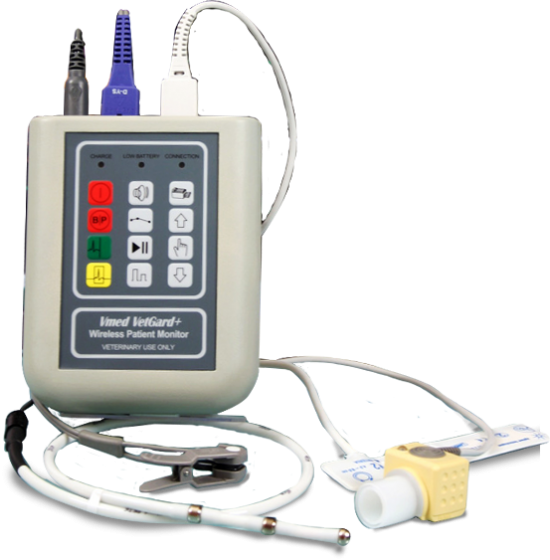
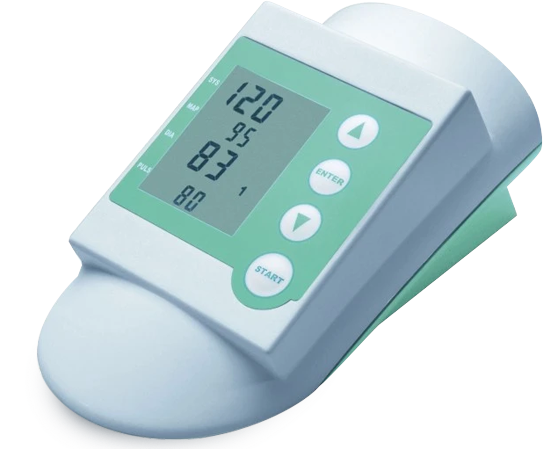
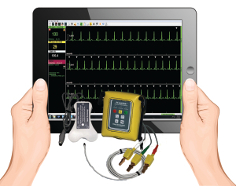
Because of the new hand-held technology, recording an ECG is a simple
task. By using the ECG, the quality of veterinary care is markedly
improved. Arrhythmias and conduction disturbances can be quickly
diagnosed and promptly treated. Hand-held units allow you to make a
diagnosis quickly, and being portable you can easily perform the test
in the exam room with the owner. If abnormalities are noted, the ECG
can be printed and faxed for a telemedicine consult. You can easily pay
for the ECG machine and generate additional income. A small screen ECG
fee of $20-$25 can be charged since the tests is so easy to do.
Considering how common heart disease is in dogs and cats, I would
estimate that most veterinary practices should be running at least
one ECG daily.
Does
the ECG need to be recorded in right lateral recumbancy? No. The position of the animal is not critical
for analyzing
abnormalities in cardiac rhythm and AV nodal conduction. Right lateral
recumbency has been established as a standard procedure for recording
the ECG. This positioning is not critical on the majority of ECG's that
are done in veterinary medicine. Right lateral recumbency is only
critical for recording the ECG when the size of the complexes and "mean
electrical axis" are used to determine heart chamber enlargement
patterns and to assess for interventricular conduction disturbances.
The ECG however is not the most sensitive or specific test for heart
enlargement and should be used mainly for rhythm evaluation. The best
way to determine heart enlargement in animals is with a chest X-ray or
echocardiogram! This is why the hand-held ECG technology is so useful
in veterinary medicine. The electrocardiogram can be recorded and an
accurate rhythm diagnosis obtained with the animal standing or sitting,
on the floor, table or in the cage.
I have trouble recording an ECG on a cat; what can I do?
With cats, you may find that the ECG complexes
are very small and the
unit may not display the heart rate. This is a common occurrence in
cats and is seen with all equipment including hand-held technology. It
is first important to check that the cause is not actual fluid in the
chest cavity. Other factors that can cause this small signal are
obesity or poor electrode contact. With the hand-held ECG technology,
the unit can be positioned in a different direction on the chest wall
and sometimes this can make the complexes larger based on how the
electrodes are aligned on that particular case. In many cases the
complexes are actually increased in size with hand-held technology
because the electrodes are actually in close proximity to the heart.
The hand-held technology is also capable of recording all of the leads
using actual electrodes that are attached to the animal's limbs. If the
complexes are too small, all of the various leads should be recorded
and in many cases, one of these leads will make it easier to see the
complexes.
What is the best paper speed to record the ECG in veterinarian medicine?
The majority of ECG's are recorded at a paper
speed of 25 or 50
mm/second. When the rate is rapid, as in cats, it often is desirable to
record the ECG at a paper speed of 50. Even when the rate is not fast,
it is often helpful to record a small portion at 50 mm/sec to make it
easier to evaluate the complexes.
Why are the complexes on some of my hand-held recordings upside down
complexes?
It is not
uncommon with the hand-held recording to have complexes that
have a negative polarity as the hand-held recording is actually
recording in many cases a precordial chest lead, very similar to what
is done when the fifth precordial chest lead of a ECG cable as
positioned over the top of the heart on the left side. Precordial chest
leads are quite useful as the complexes are often increased in size and
are often easier to determine P-QRS complexes even though the complexes
may be "upside down." Remember, primary focus with the ECG is heart
rate, analyzing any arrhythmias, and also conduction analysis. To
determine if the heart is enlarged, the chest X-ray or the ultrasound
study is the most accurate test.
I'm in a large animal practice.
Are hand held units useful in horses?
Yes. One advantage of the hand-held units in
large animal practice is
the portability. They are small and battery operated, so you can easily
bring them into a barn, field, or racetrack and obtain an ECG. This can
be quite useful for a horse that quits in a race or during training and
you suspect a transient arrhythmia. Immediately after a race or
training period, the hand-held unit can be placed on the horse's chest
and the rhythm observed. Any abnormalities can be saved and printed for
further analysis.
|